Digital Inequality & the Geography of Creator Labor
How economic systems shape creative behavior in the digital economy
Sole-authored Undergraduate Research Project conducted through the University of Minnesota Undergraduate Research Opportunities Program (UROP).
Dec, 2025
Why this project matters
The creator economy is often described as open and location-independent. In theory, anyone with internet access can participate.
In practice, creators remain geographically clustered—and some high-income areas appear to lose creators rather than attract them.
This project asks a systems-level question:
“When creative work is risky, how do economic incentives shape human decision-making—and who gets pushed out?”
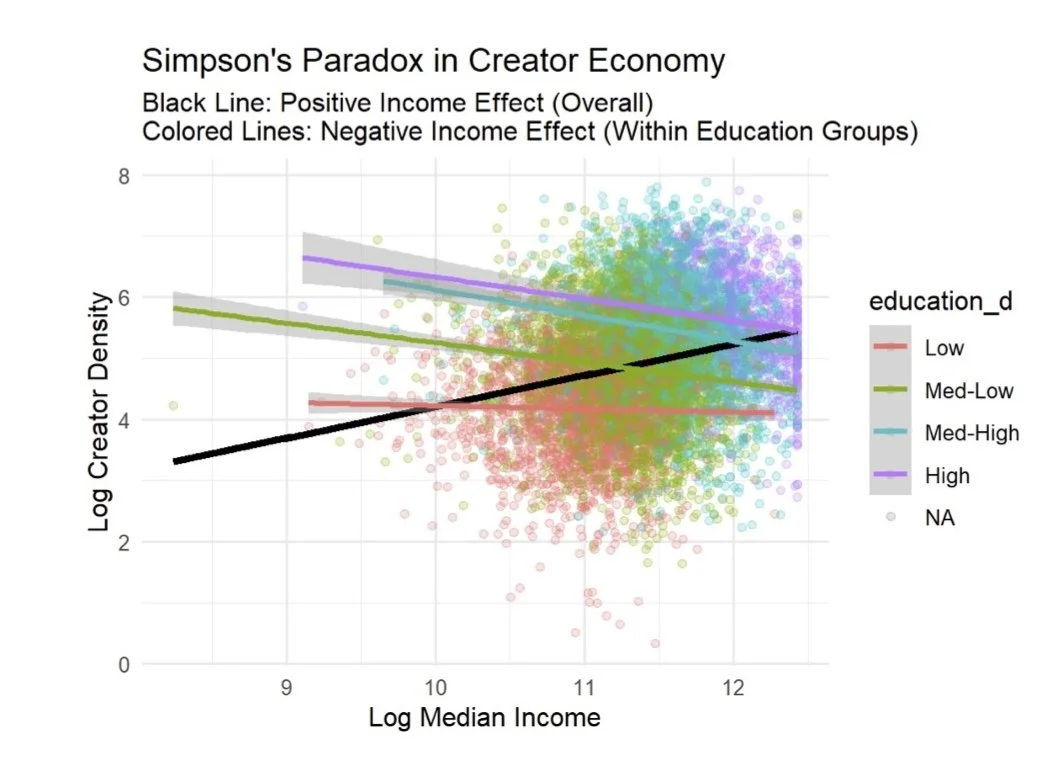
Aggregate income appears to attract creators, but within education groups, higher income consistently reduces creative participation.
What I discovered
Using census-tract data from 10 major U.S. metropolitan areas, I identified a structural anomaly known as Simpson’s Paradox.
At the aggregate level, higher-income neighborhoods appear to host more creators
Once education is held constant, higher income consistently reduces creator participation
This reveals a misalignment between economic systems and human creative behavior.
How the system works: The Triangle Mechanism
To explain this reversal, I developed a causal framework separating human capital from financial capital.
Education builds creative capability and access to high-paying traditional jobs
Income, once education is controlled for, reflects opportunity cost
High-income labor markets raise the cost of creative risk-taking
As a result, capable individuals rationally opt out of creative work—even when they have the skills to succeed.
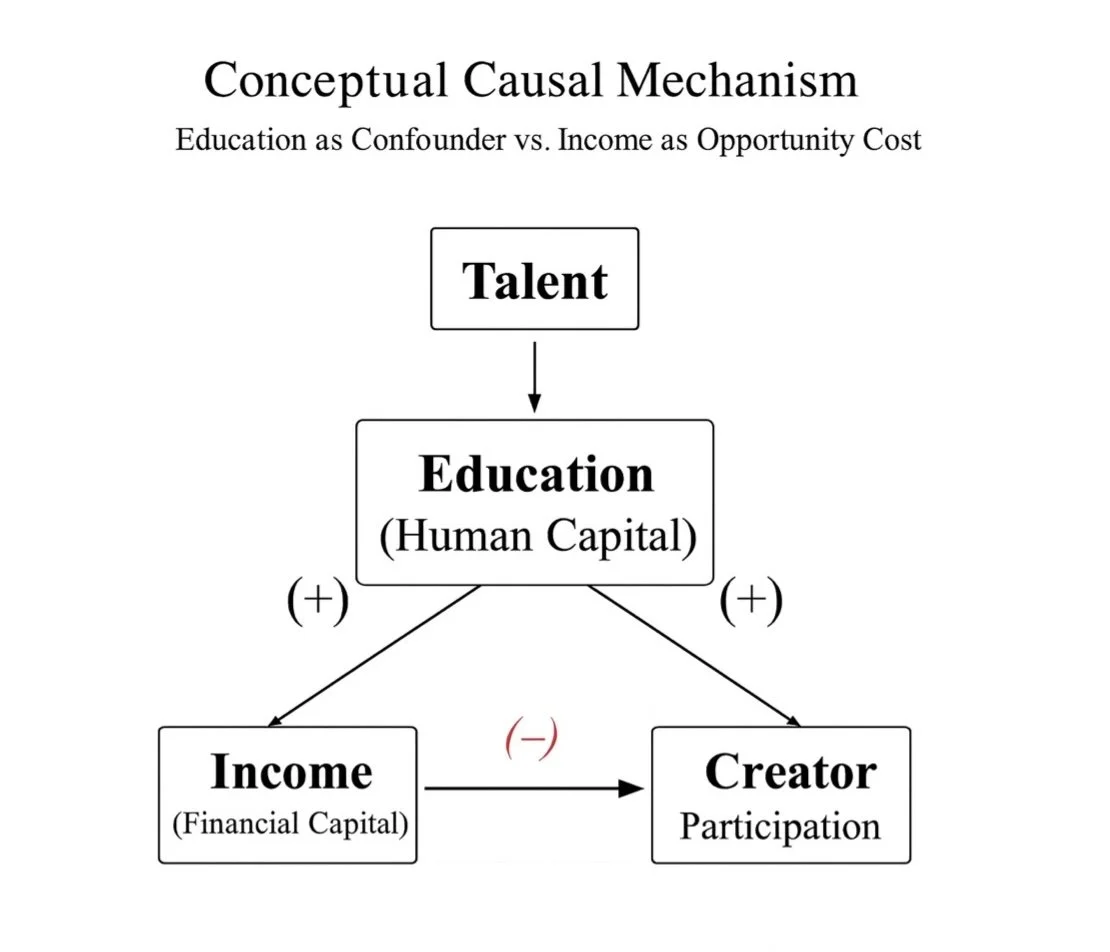
Education drives both income and creative capability, while income increases opportunity cost and crowds out creative labor.
Methods & tools
This project emphasizes system explanation, not just prediction.
American Community Survey (ACS), census-tract level
Fixed-effects regression across 10 U.S. metropolitan regions
Subgroup analysis by education level
Monte Carlo simulation to test causal structure
Spatial analysis and data visualization
Spatial patterns of human capital
Mapping educational attainment across cities reveals a consistent pattern:
creator hotspots align with education clusters, not necessarily with wealth.
This distinction highlights the difference between financial capital and human capital in shaping digital participation.
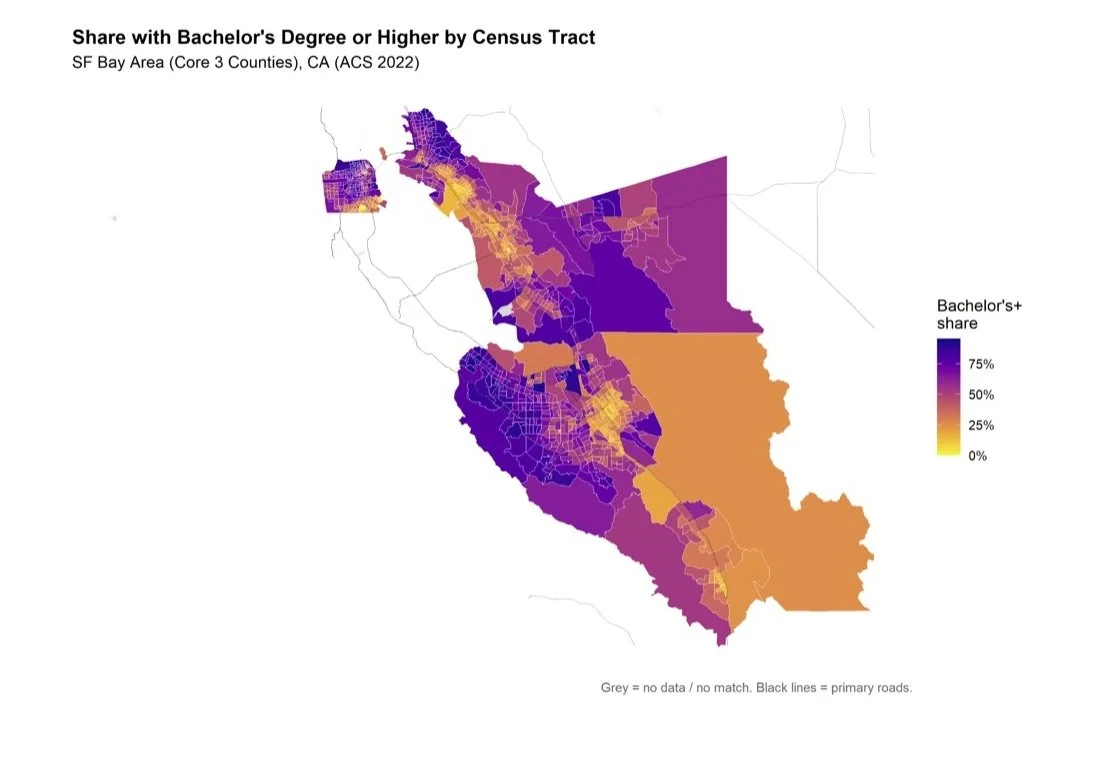
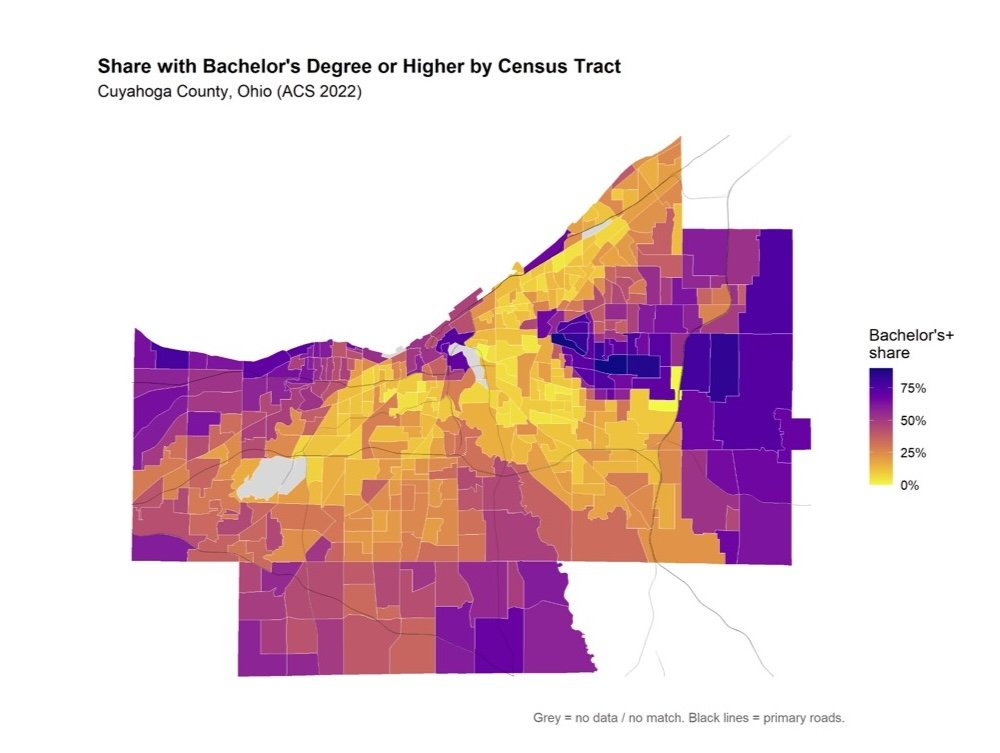
High creator density overlaps with education concentration rather than income centers.
What this reveals about digital inequality
This research challenges the assumption that economic prosperity alone fuels creative ecosystems.
Key insights:
Education—not income—is the primary engine of digital participation
High-income systems can unintentionally suppress creativity
Digital inequality today is driven by skills, incentives, and risk, not access alone
These findings have implications for:
platform and product design
education systems
urban and labor policy
creator tools and digital platforms
AI and future-of-work research
Full Research Paper
Digital Inequality and the Geography of Creator Labor:
Evidence of Simpson’s Paradox in U.S. Cities