Toward an Integrated Career Development Ecosystem
Reframing higher-education career technologies through reflection, sensemaking, and student-generated data
Research Assistant — Lo/Be Lab
Conceptual research and system design developed for higher-education career services
2025
Overview
This project investigates why existing career technologies in higher education often fail to support students’ long-term understanding, identity development, and decision-making. Rather than focusing on individual tools or features, the work examines career services as a learning system and asks how reflection, data, and visualization might be integrated to support sensemaking over time.
Drawing on learning sciences and human–computer interaction (HCI) perspectives, the project proposes a conceptual framework for an integrated, student-centered career ecosystem—one that treats reflection as a core learning practice and student-generated information as a meaningful source of insight rather than institutional metrics.
Problem Context
Most higher-education career technologies are organized around discrete functions such as onboarding surveys, résumé uploads, skill inventories, advising appointments, and networking platforms. While these tools may be useful individually, they are rarely designed to work together as a coherent developmental system.
As a result, students encounter career services as a series of disconnected tasks rather than as a process that helps them integrate experiences, reflect on growth, or develop a narrative understanding of who they are becoming. Reflection, skill development, and career mapping are typically separated, forcing students to perform the work of integration themselves.
From a learning sciences perspective, this fragmentation undermines sensemaking. From an HCI perspective, it increases cognitive load by requiring users to mentally reconcile information across systems rather than through designed representations.
Conceptual Approach
This project approaches career development as a longitudinal learning process, not a checklist. The proposed ecosystem is grounded in three core ideas:
Student-generated information as a developmental resource
Experiences, reflections, activities, skills, and goals are treated as evolving sources of insight rather than static data points.
Reflection as structured learning practice
Guided journaling and reflective prompts are positioned as central mechanisms for interpretation, not peripheral activities.
Integration through shared representations
Visualization and mapping connect reflection, experience, and action into a coherent narrative across time.
Rather than optimizing for immediate outcomes, the system emphasizes coherence, revisitation, and interpretation.
Welcome
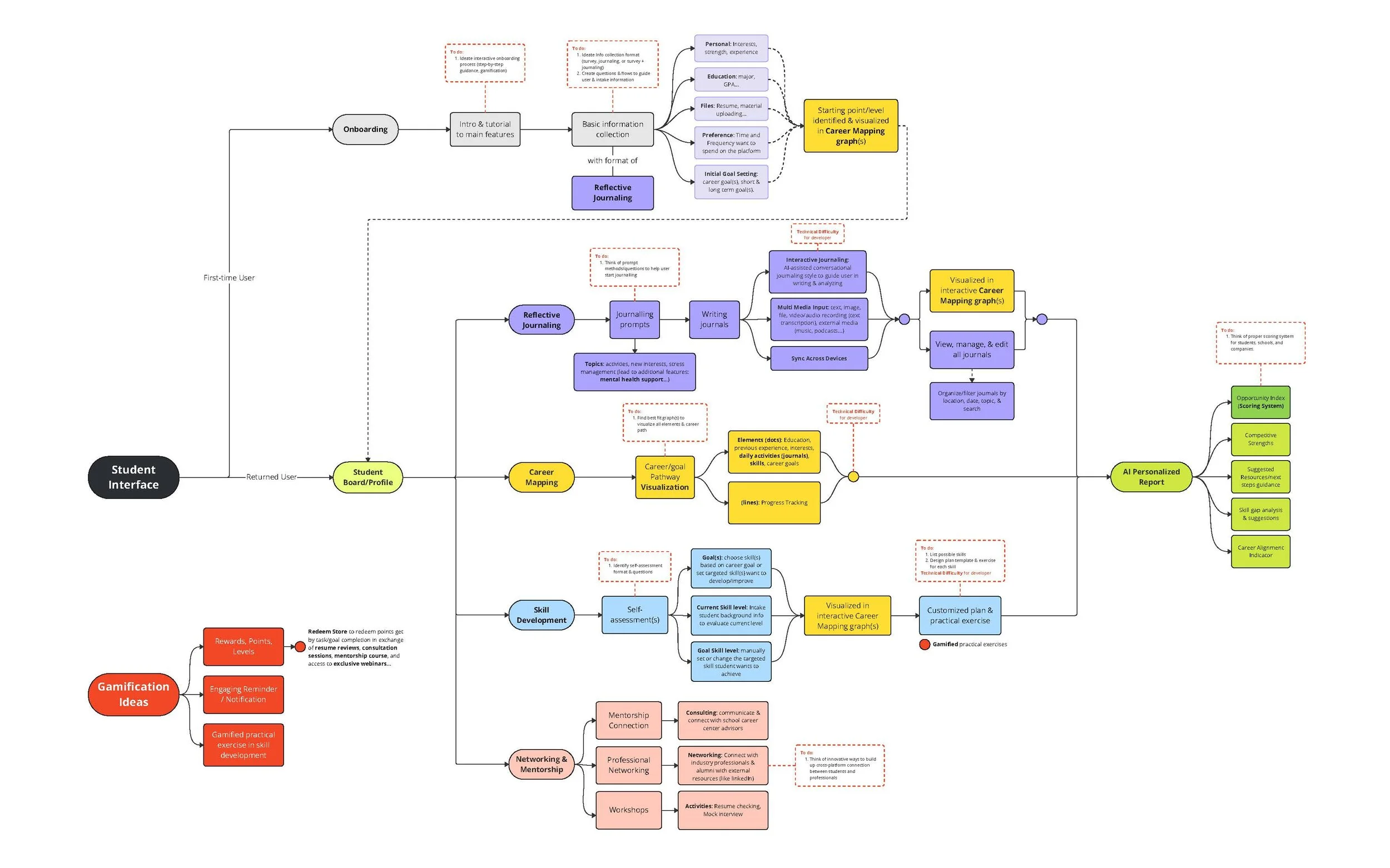
Explore the platform flow based on your architecture map.
Learning Sciences & HCI Foundations
The conceptual framework draws on established ideas from the learning sciences and human–computer interaction:
Sensemaking and reflection: Learning emerges through interpretation of experience rather than task completion
External cognition: Visual representations reduce cognitive load and support reasoning across time
Identity development: Career direction evolves through iterative reflection and narrative construction
Human-centered decision support: Systems should support judgment and agency rather than prescribe outcomes
Within this framing, technology serves as a mediating structure—helping students see patterns in their experiences—rather than as an authority that determines direction.
From Understanding to Action
In the proposed ecosystem, action-oriented components such as skill development, mentorship, and networking are intentionally positioned after reflection and interpretation. This sequencing reflects the belief that meaningful action depends on prior understanding.
When students can articulate values, recognize patterns in their experiences, and see how different elements connect, decisions about skills to develop or opportunities to pursue become more intentional and less reactive.
My Contributions
As a research assistant at Lo/Be Lab, I supported this project through research and synthesis rather than system ownership. My contributions included:
Assisting with research and case study analysis on higher-education career technologies
Supporting literature review and organization related to learning sciences and HCI perspectives
Creating and refining conceptual diagrams that articulated system logic and relationships
Helping structure and clarify the conceptual framework into a coherent narrative
Through this role, I gained experience working on early-stage conceptual research that bridges theory, system design, and educational practice.
Outcome
The outcome of this project is a conceptual framework rather than a finished product. It provides a structured way to understand why existing career technologies fall short and offers a foundation for designing integrated systems that support reflection, coherence, and intentional decision-making.
The framework can inform future design research, prototyping, and institutional experimentation in higher-education career services.
Key Learnings
This project strengthened my interest in how learning theory, system design, and visualization can be combined to support human sensemaking. It also deepened my understanding of how educational technologies can unintentionally constrain learning when they prioritize tasks over interpretation.
Working on this conceptual research highlighted the importance of designing systems that align with how people actually learn, reflect, and develop over time.